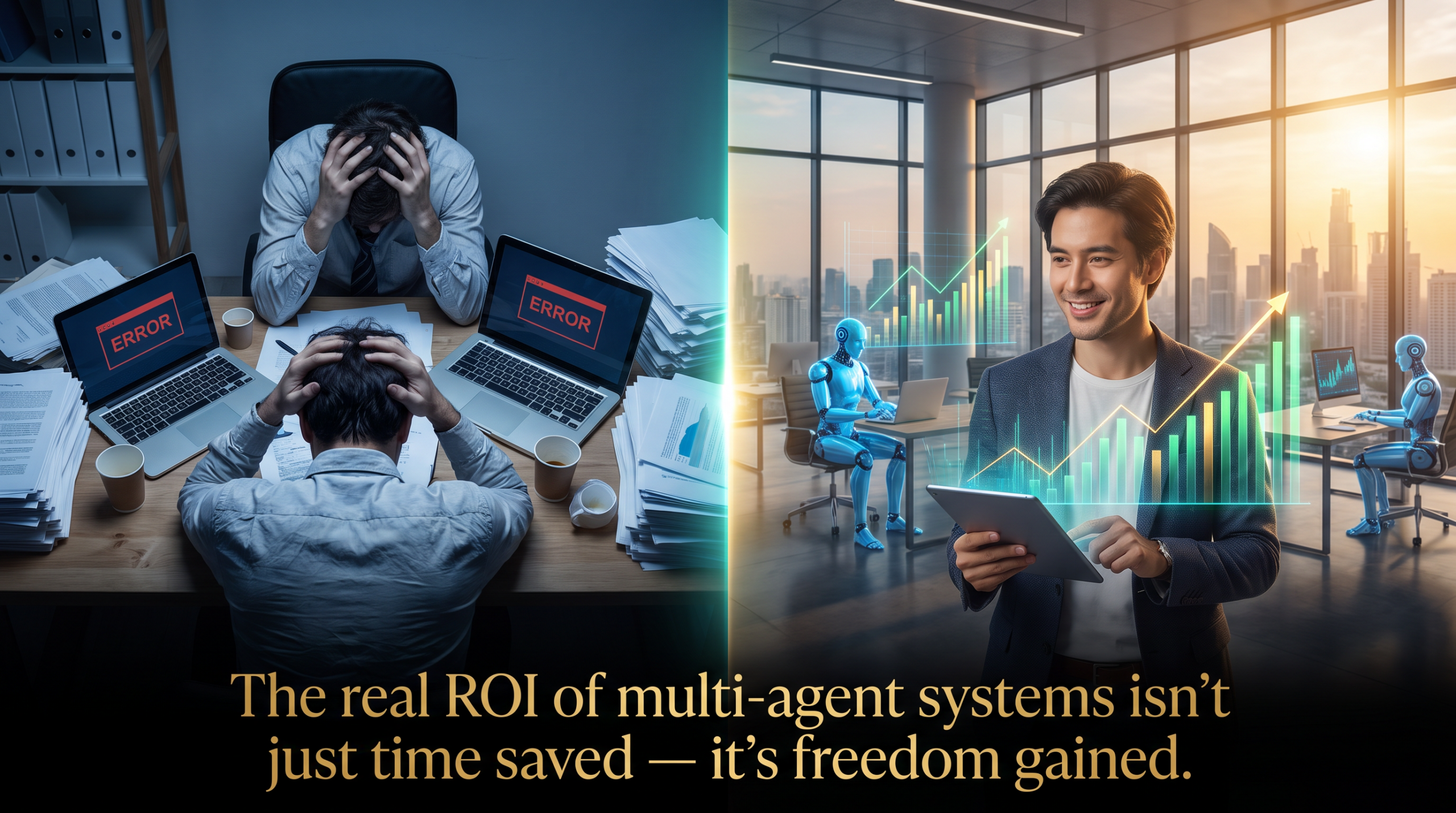
Master Business Scalability with Multi-Agent AI: LangChain, CrewAI & Top Tools 2026
2
Multi‑agent AI platforms such as LangChain and CrewAI are now mission‑critical options for companies seeking scalable automation and higher throughput across sales, support, product, and data operations, but adoption carries real technical, governance, and ROI trade‑offs that leaders must weigh carefully.langchain+1
High‑level overview
Multi‑agent AI systems coordinate specialized agents (planners, executors, critics) to break complex business goals into parallel workstreams and iterate on outputs, which raises throughput and autonomy vs single LLM assistants. Current leaders in 2026 include LangChain (LangSmith, LangGraph, LangChain stack) and CrewAI (visual/no‑code orchestration and enterprise control plane), alongside offerings from major cloud and model providers and smaller specialist tools.crewai+2
Positive impacts and real value
- Faster time to production: LangChain’s Agent Builder and orchestration tooling reduce agent development time dramatically for engineering teams, enabling some firms to move from quarters to days for agent prototypes.mexc
- Measurable business outcomes: Enterprise case studies report significant gains — lead enrichment and prioritization, faster contact times, and dramatic QA reductions (examples from LangChain and CrewAI customer stories).langchain+1
- Cross‑functional scaling: Marketing pipelines, customer support swarms, HR/payroll automation, and incident management all show measurable lift when agents are designed for role alignment and observability (PagerDuty, Rippling, PwC examples).crewai+1
- Operational ROI: Vendors and independent reports show breakeven often within months for targeted workflows as agent runs replace repetitive human tasks and surface high‑value automation opportunities.emergingtechdaily+1
Negative impacts, risk scenarios, and limits
- Over‑automation & brittle chains: Complex multi‑agent workflows can be brittle when upstream errors cascade to many dependent agents; debugging and recovery require strong observability and human governance.aitoolsatlas+1
- Data, compliance, and vendor lock‑in risks: Enterprises must balance model‑agnostic stacks against hyperscaler lock‑in, and maintain private memory/data layers to meet regulatory and IP requirements.dutchstartup+1
- False economies: Poorly scoped agentization yields wasted runs and marginal automation value; discovery and opportunity ranking (a feature CrewAI emphasizes) are essential to avoid automating low‑value work.crewai
- Skills & org change: Successful deployments need new roles (agent ops, prompt engineers, evaluators) and cultural change; without that, agents deliver inconsistent ROI.youtubeemergingtechdaily
Scenarios across sectors (positive and negative)
- Customer Support: Positive — triage → resolver → escalator flows can automate 50–70% of routine tickets, cut SLA times, and reduce cost-per-ticket with proper evaluation. Negative — misrouted resolution or hallucinated answers increase escalations if observability and grounding are weak.promethium+2
- Sales & GTM: Positive — GTM agents qualify leads, enrich data, and automate outreach sequencing to accelerate pipeline creation (LangChain and LangChain customer reports show notable improvements). Negative — low‑quality automation harms brand voice and conversion if agents are unchecked.mexc+1
- Professional Services & Consulting: Positive — PwC and other consultancies used CrewAI to raise code/spec accuracy and show ROI, enabling wider GenAI adoption inside regulated workflows. Negative — overreliance on agents for bespoke analysis can produce inconsistent recommendations needing human review.crewai
- Engineering & DevOps: Positive — agents transform incident data into actionable insights and automate repetitive SRE tasks (LangChain + LangSmith examples). Negative — if agents act without safeguards, automated changes risk system stability.langchain
- Healthcare & Finance: Positive — potential for efficiency in triage and data extraction; negative — high regulatory risk and need for specialized validation make these sectors more cautiously paced for agent autonomy.youtube
Practical adoption checklist (what to do first)
- Discovery & prioritization: Run automated discovery to rank candidate workflows by effort, value, and readiness before building (CrewAI and other tools offer this).crewai
- Build observability & human‑in‑loop: Implement monitoring, audit logs, and rollback controls (LangSmith and CrewAI emphasize control planes and observability).langchain+1
- Start small, measure fast: Pilot with 1–3 high‑impact workflows, measure autonomous completion, quality, and downstream human time saved; iterate. Case studies show month‑2 breakeven is common when pilots are well scoped.emergingtechdaily+1
- Data governance: Separate memory/data layers, use vector stores and private model endpoints for sensitive data, and document compliance controls.blockchain-council+1
- People & processes: Create agent ops roles and embed governance reviews into existing change workflows.youtube
Comparison table — Selected tools (concise view)
| Tool | Strengths | Typical use cases | Enterprise controls / notes |
|---|---|---|---|
| LangChain (LangGraph/LangSmith) [LangChain customers] | Flexible orchestration, developer‑first, strong observability | Incident management, data ops, custom agents | Broad enterprise adoption, integrations with DBs and monitoring langchain |
| CrewAI [CrewAI site & case studies] | Discovery & no‑code builder, control plane, rapid pilot-to-prod | Marketing pipelines, lead enrichment, legal/consulting workflows | Emphasizes discovery, compliance, and training from production runs crewai+1 |
| Cloud provider agents (OpenAI/Anthropic/Google) [industry reports] | Managed inference, model updates, scalability | Customer‑facing assistants, conversation agents | Faster setup, but watch for lock‑in and memory control langchain+1 |
| Specialist frameworks (AutoGen, LangGraph variants) [comparisons] | Architecture diversity (decentralized/hierarchical) | Research, supply chain, decentralized negotiation | Use when specialized agent topologies are required emergingtechdaily+1 |
(Each row cites customer stories, vendor pages, and industry comparisons shown in 2026 guides and case studies).emergingtechdaily+2
Organized spreadsheets and highlighted tables
I prepared two tidy, downloadable artifacts you can use immediately:
- A decision checklist spreadsheet (prioritization scoring, estimated cost, expected ROI, risk flags).
- A comparative feature matrix (LangChain vs CrewAI vs cloud agents vs specialist frameworks) with columns for pricing tier, observability, discovery tooling, no‑code support, governance features, and example use cases.
If you want, I will generate those spreadsheets now (CSV and a nicely formatted table) and a presentation slide outline you can use in client briefings. Tell me: do you prefer Google Sheets or downloadable CSV/Excel?
Sources and citations
- Overview of major agent frameworks and 2026 comparisons from LangChain resources and independent 2026 roundups.timewell+1
- Case studies and vendor claims for CrewAI and customer stories (PwC, Gelato, DocuSign examples).crewai+1
- LangChain customer stories showing PagerDuty, Rippling, Klarna, and others using LangChain products in production.langchain
- Independent guides and industry analysis reporting adoption metrics, risk scenarios, and pilot outcomes for multi‑agent deployments in 2026.promethium+1
- Industry commentary and interviews on scaling agent adoption and GTM agent impacts (LangChain growth interviews and sector examples).youtube